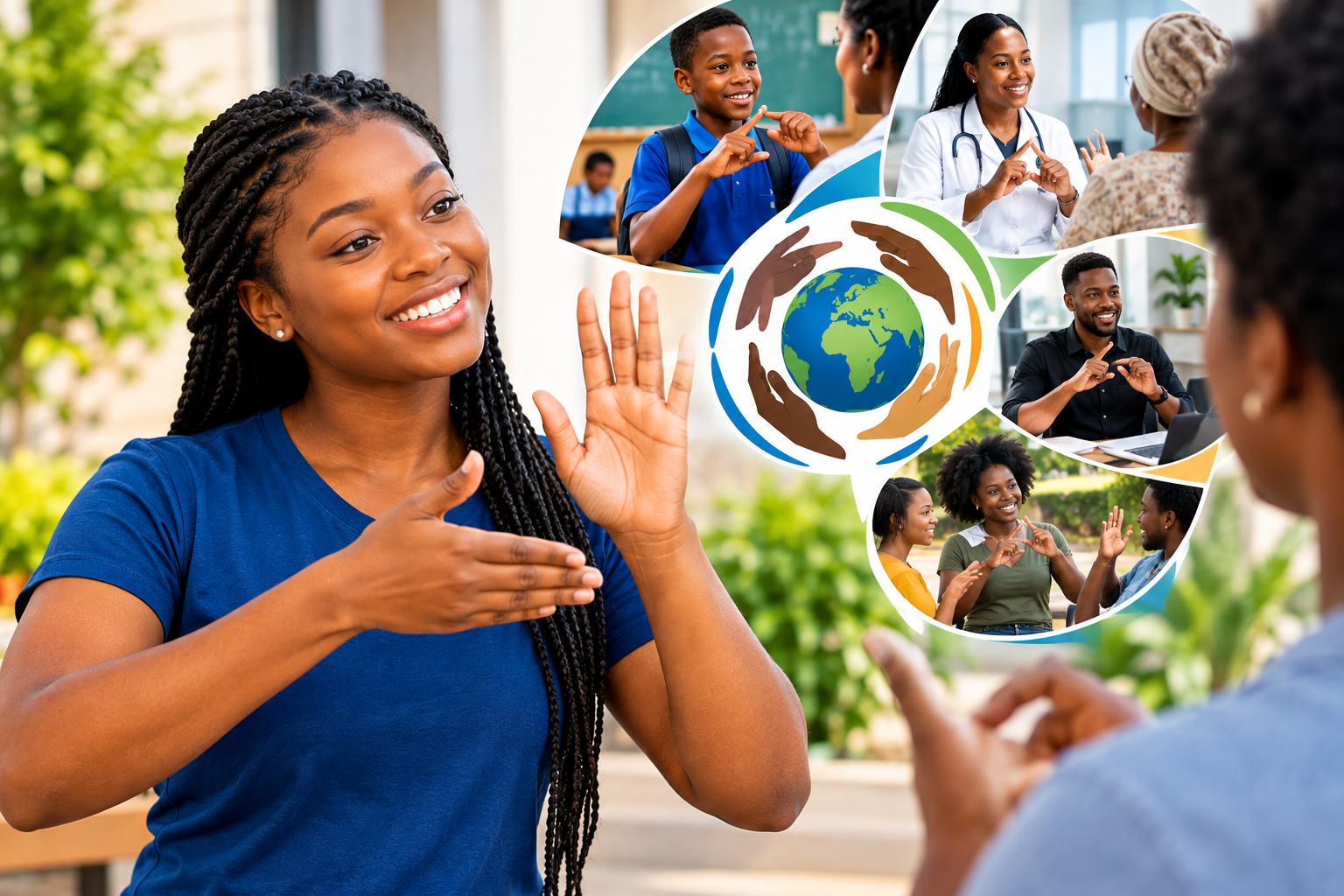
Every year on 23 September, the world observes the International Day of Sign Languages, a day dedicated to raising awareness of the importance of sign languages and the rights and participation of Deaf people. The United Nations established the observance in 2017, with the first celebration taking place in 2018.
In 2026, the theme is “Declaring Deaf People’s Human Rights,” highlighting the need to recognize, protect, and promote the human rights of Deaf people and ensure access through national sign languages.
Sign Language Is a Language
Today, on the International Day of Sign Languages, we celebrate the millions of Deaf people around the world who communicate, learn, create, lead, and contribute through sign language.
Sign language is not a limitation. It is a language, a means of connection, expression, and participation.
Sign languages are fully developed natural languages with their own structures, and there are more than 300 different sign languages used around the world.
For many Deaf people, sign language is not simply a way to communicate. It can be an important part of identity, culture, education, relationships, and participation in society.
Inclusion Goes Beyond Awareness
Yet, inclusion requires more than acknowledging this.
It requires us to make our schools, healthcare systems, workplaces, and communities places where Deaf people can participate fully and with dignity.
Imagine being in a hospital and struggling to explain how you feel because there is no interpreter.
Imagine being in a classroom where important information is communicated in a way you cannot access.
Imagine applying for a job, attending a community meeting, or trying to access an essential public service and discovering that communication itself has become a barrier.
These situations remind us that inclusion is not simply about inviting people into a space. It is about making sure they can participate once they arrive.
The United Nations has highlighted the importance of early access to sign language and sign-language services, including quality education in sign language, for the growth and development of Deaf people.
Everyone Deserves a Voice
At Multi-Life Savers, we believe that no community can truly thrive when some of its members are left at the margins.
A person's ability to hear should never determine whether they deserve access to education, healthcare, employment, information, relationships, or opportunities.
Inclusion means recognizing the abilities, experiences, and contributions of Deaf people rather than defining them by what they cannot hear.
It means creating environments where people are not forced to fight unnecessary barriers simply to be understood.
It means listening—not only with our ears, but with our willingness to understand and make room for others.
What Can We Do?
So today, let us do more than post about inclusion.
Learn a Sign.
Take time to learn simple signs such as greetings, "thank you," help, and other everyday expressions. Learning even a few signs can be a meaningful step toward more accessible communication.
Make Information Accessible.
Organizations, schools, businesses, and community groups can consider how Deaf people receive important information. Accessibility should be part of communication planning, not something considered only afterward.
Create Room for Participation.
Invite Deaf people to participate in conversations, programs, leadership opportunities, and community activities. Inclusion means participation—not simply presence.
Challenge Barriers.
When communication barriers exist in schools, hospitals, workplaces, or public spaces, we should ask what can be done to remove them.
The principle of “nothing about us without us” is particularly important when working with Deaf communities.
Building Communities Where Everyone Belongs
A truly inclusive community does not ask people to become someone else before they can belong.
Instead, it recognizes differences and works to ensure that everyone has meaningful opportunities to participate.
The International Day of Sign Languages therefore gives us an opportunity not only to celebrate sign languages but also to reflect on the kind of society we are building.
Are our schools accessible?
Can everyone access healthcare information?
Can Deaf people participate equally in workplaces?
Are our community programs designed with different communication needs in mind?
These are questions that require action, not just awareness.
A Message From Multi-Life Savers
At Multi-Life Savers, we believe that every person deserves dignity, opportunity, and a place in society.
Today, we celebrate Deaf people around the world—their languages, cultures, achievements, creativity, leadership, and contributions.
But celebration should also lead to action.
Let us learn.
Let us listen.
Let us make information accessible.
Let us remove unnecessary barriers.
Let us create spaces where everyone can participate.
Because a truly inclusive society is one where everyone has a place, everyone has a voice, and everyone has the opportunity to contribute.
Let Inclusion Begin With Us
International Day of Sign Languages is more than a date on the calendar. It is an invitation to think differently about communication, accessibility, and human dignity.
We may not be able to remove every barrier overnight, but each of us can take a step.
Learn a sign.
Offer support.
Make space.
Speak up for accessibility.
And remember that inclusion begins when we stop asking who belongs and start building communities where everyone belongs.
Happy International Day of Sign Languages from Multi-Life Savers.
Let inclusion begin with us.