Sometimes, Love Looks Like Showing Up.
The rain had been falling since early morning.
By afternoon, the streets were muddy, the gutters were overflowing, and most people were eager to remain indoors.
Chika stood by the window of her small apartment, watching the rain fall heavily.
She had planned to visit the market that day, but the weather had changed everything.
As she turned away from the window, she heard someone knocking gently on her door.
It was her neighbor, Mama Ngozi.
The elderly woman stood outside, completely soaked.
“Please, Chika,” she said softly, “do you have a little food I can use to prepare something?”
Chika looked at her.
Mama Ngozi lived alone. Her children had moved to different cities, and although they occasionally sent money, there were times when things became difficult.
Chika immediately went to her kitchen.
She brought out some rice, beans, vegetables, and other food items.
“Take these,” she said.
Mama Ngozi smiled.
“Thank you, my child.”
Chika smiled back.
“It is nothing.”
But as she watched the elderly woman walk away, something occurred to her.
Perhaps it wasn't nothing.
Perhaps it was love.
What Does It Really Mean to Love Your Neighbor?
We often hear the words, “Love your neighbor as yourself.”
But what does loving our neighbors actually look like?
Is it simply saying nice things?
Is it posting inspirational messages online?
Is it attending community events?
Or is love something we demonstrate through the ordinary things we do every day?
Chika began to understand that love is often practical.
Sometimes it is food.
Sometimes it is encouragement.
Sometimes it is a helping hand.
Sometimes it is simply asking:
“Are you okay?”
The Neighbor We Often Don't Notice
A few days later, Chika noticed a young man named Emeka sitting outside his house.
He had recently lost his job.
Every morning, he dressed neatly, picked up his documents, and went out looking for work.
Every evening, he returned quietly.
One afternoon, Chika approached him.
“Emeka, how are you doing?”
He smiled.
“I am fine.”
But she could see that he wasn't.
Instead of walking away, she sat beside him.
“Tell me what is happening.”
For the first time in weeks, Emeka talked about his worries.
He spoke about applications that received no response, bills that were piling up, and the fear of disappointing his family.
Chika listened.
She didn't have a job to offer him.
She didn't have enough money to solve all his problems.
But she had something valuable.
Her presence.
Before leaving, she told him:
“Don't give up. I may not have the solution today, but I will keep checking on you.”
Sometimes, loving someone means refusing to let them feel invisible.
Love Is More Than Giving Money
Many people think helping others requires financial resources.
But love doesn't always come with money.
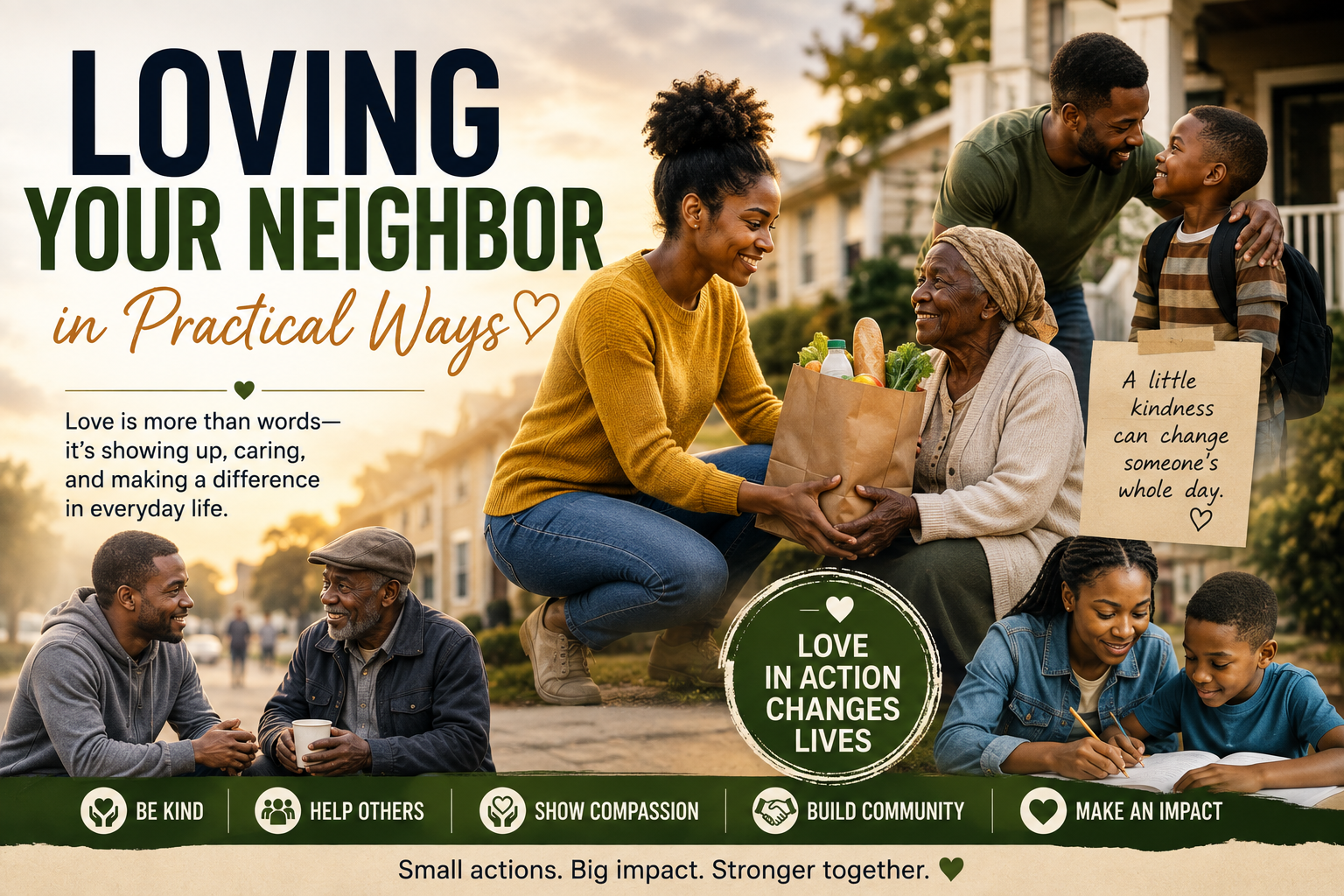
You can love your neighbor by:
- Helping an elderly person cross the road.
- Sharing food with a struggling family.
- Checking on someone who has been unusually quiet.
- Helping a child with schoolwork.
- Visiting someone who is sick.
- Sharing useful information about an opportunity.
- Offering transportation when someone is stranded.
- Listening to someone without judging them.
- Helping a neighbor during an emergency.
- Speaking up when someone is being treated unfairly.
Sometimes, your time may be more valuable than your money.
Sometimes, your encouragement may be more important than a gift.
And sometimes, simply being there can make someone's difficult day a little easier.
A Small Act That Changed a Child's Day
One Saturday, Chika noticed a young boy sitting alone near the community center.
His name was Daniel.
He watched other children playing but didn't join them.
“Why aren't you playing with the others?” Chika asked.
The boy looked down.
“My school shoes are torn,” he replied.
Chika looked at his shoes.
They were indeed badly damaged.
She didn't embarrass him.
She simply smiled and said:
“Come with me.”
She took him to a nearby shop and bought him a simple pair of school shoes.
Daniel could hardly contain his excitement.
“Thank you!”
Chika smiled.
“Now promise me you'll take good care of them.”
Daniel nodded enthusiastically.
The shoes were small.
The gesture was simple.
But for Daniel, it meant something much bigger.
Someone had noticed him.
Someone cared.
Someone believed he mattered.
Love Sometimes Requires Courage
Loving our neighbors isn't always convenient.
Sometimes it means speaking up when someone is being mistreated.
Sometimes it means defending someone who cannot defend themselves.
Sometimes it means helping someone even when there is nothing to gain.
And sometimes it means forgiving.
Chika learned this when two families in the neighborhood began arguing over a piece of land.
The disagreement quickly became bitter.
People began taking sides.
Instead of adding fuel to the situation, Chika encouraged both families to sit down and talk peacefully.
“Being right is not always more important than preserving peace,” she told them.
The conversation wasn't easy.
There were accusations and painful words.
But eventually, both sides agreed to seek a peaceful solution.
Chika realized that loving one's neighbor sometimes means becoming a bridge instead of another wall.
The Community Begins to Change
Something unexpected happened.
People began noticing what Chika was doing.
A woman started taking meals to an elderly neighbor.
A group of young people began cleaning the streets every Saturday.
A shop owner started allowing struggling parents to purchase essential items and pay later.
Some youths began tutoring children who were struggling academically.
People started checking on one another.
The community was changing.
Not because someone had given a powerful speech.
Not because a wealthy organization had arrived.
But because ordinary people had started practicing love in ordinary ways.
One act inspired another.
Then another.
And another.
A Faith-Based Reflection
Many faith traditions teach that love is not merely something we feel—it is something we do.
To love our neighbors is to recognize the dignity and worth of every human being.
It means feeding the hungry, comforting the grieving, encouraging the discouraged, welcoming the lonely, helping the vulnerable, and standing with people during difficult seasons.
Faith becomes more meaningful when it moves beyond words and becomes visible through service.
A simple act of kindness can become a powerful expression of God's love.
We may never know how far that kindness travels.
From Me to You
Look around you.
There may be someone nearby who needs help.
Maybe it is the elderly neighbor who rarely receives visitors.
Maybe it is the young person searching for employment.
Maybe it is a family struggling to provide food.
Maybe it is someone silently battling discouragement.
Maybe it is simply a person who needs someone to listen.
You don't have to solve every problem.
Start with what you can do.
Share what you have.
Give your time.
Offer encouragement.
Listen.
Serve.
Forgive.
Check on someone.
And when you see a need you can meet, don't always wait for someone else to act.
You might be the answer to someone's prayer.
The Bottom Line
Loving your neighbor is not always about extraordinary sacrifices.
More often, it is found in ordinary moments.
A meal shared.
A door opened.
A hand extended.
A conversation offered.
A burden carried.
A person encouraged.
A lonely neighbor remembered.
These small acts may appear insignificant, but they can make a tremendous difference in someone's life.
A compassionate community is built when people stop asking, “What is someone else going to do?” and start asking, “What can I do?”
Because love is not only something we say.
Love is something we practice.
And sometimes, the greatest way to change the world is to start with the person standing right next to you.