When champions stumble, the story is not necessarily over—it may simply be the beginning of a new chapter.
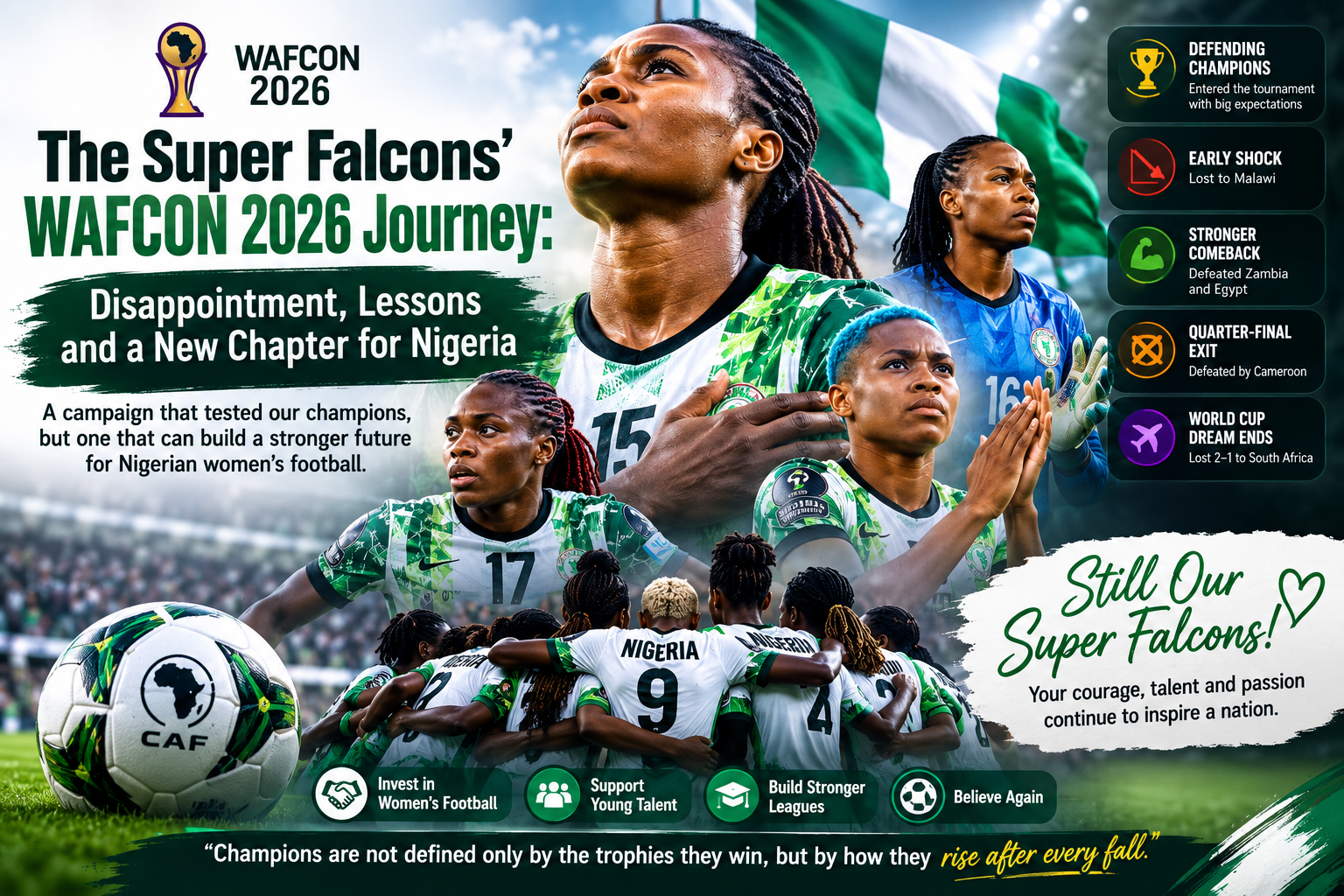
The 2026 Women’s Africa Cup of Nations (WAFCON) has been a tournament of unexpected results, emotional moments, and difficult lessons for Nigeria's Super Falcons.
As the defending champions and Africa's most successful women's national team, Nigeria entered the tournament in Morocco with enormous expectations. The Super Falcons were chasing an unprecedented 11th continental title after winning their record-extending 10th WAFCON trophy in 2024.
But football does not always follow history.
This year's campaign ended in disappointment, with Nigeria eliminated in the quarter-finals by Cameroon before a 2–1 defeat to South Africa in the World Cup play-off ended the country's hopes of appearing at the 2027 FIFA Women's World Cup.
For the first time since the Women's World Cup began in 1991, Nigeria will not be at the global tournament.
A Difficult Beginning Against Malawi
Nigeria's WAFCON campaign began on 28 July with a result few expected.
The Super Falcons faced WAFCON debutants Malawi but suffered a surprising 3–2 defeat.
For a team carrying the reputation of ten-time African champions, the result immediately placed pressure on Nigeria.
The defeat was particularly significant because Malawi was appearing at the WAFCON finals for the first time.
But rather than allowing the result to define their campaign, Nigeria responded.
The Super Falcons Fight Back
Nigeria knew that there was little room for another mistake.
Their second Group C match was against Zambia, and the Super Falcons delivered when it mattered.
Despite being reduced to ten players, Nigeria secured a narrow 1–0 victory, with Asisat Oshoala scoring the decisive goal.
The result revived Nigeria's hopes of progressing to the knockout stages.
The final group match against Egypt produced an even stronger response.
Nigeria defeated Egypt 6–2 in a commanding performance, securing their place in the quarter-finals.
The victory demonstrated the attacking quality and resilience that had made the Super Falcons one of Africa's dominant teams for decades.
Cameroon Ends Nigeria's Title Defense
Then came one of the biggest matches of the tournament.
Nigeria faced Cameroon in the quarter-finals.
It was a familiar rivalry. The two nations had already met 13 times at the WAFCON finals, making it the most-played fixture in the competition's history. Nigeria had dominated the rivalry, winning nine meetings in open play and two more on penalties before this encounter.
But past records could not determine what would happen on the pitch.
Cameroon produced a disciplined performance and defeated Nigeria 1–0.
The decisive moment came in the 19th minute when 20-year-old Myriam Wamen scored with a powerful long-range effort.
Nigeria's quest for an 11th WAFCON title was over.
For Nigerian supporters, it was a painful moment.
The reigning champions had entered Morocco hoping to defend their crown, but their journey had ended much earlier than expected.
A Second Chance for the World Cup
Although the quarter-final defeat ended Nigeria's hopes of winning WAFCON 2026, there was still something important at stake.
The tournament also served as part of Africa's qualification pathway for the 2027 FIFA Women's World Cup.
Because Nigeria had failed to reach the WAFCON semi-finals, the Super Falcons had to fight through a play-off against another quarter-finalist, South Africa.
The stakes could hardly have been higher.
Win, and Nigeria would keep their World Cup hopes alive.
Lose, and a remarkable record would come to an end.
South Africa Ends Nigeria's World Cup Dream
On 13 August, Nigeria faced South Africa in Casablanca.
The first half ended goalless, but South Africa eventually broke the deadlock through Thembi Kgatlana in the 56th minute.
Refiloe Jane then doubled South Africa's advantage in the 77th minute.
Nigeria refused to give up.
Deep into stoppage time, a VAR review led to a penalty for the Super Falcons, and Christy Ucheibe converted to make it 2–1.
There was still a brief opportunity for Nigeria to find an equalizer, but South Africa held on for victory.
The result ended Nigeria's hopes of qualifying for the 2027 Women's World Cup.
For the first time in the history of the competition, the Super Falcons will not participate in the Women's World Cup.
More Than a Football Defeat
For Nigerians, this is understandably difficult to accept.
The Super Falcons have long been one of the most consistent teams in African women's football.
They have won the WAFCON more times than any other nation and have represented Africa at every Women's World Cup since the competition began.
That remarkable record has now come to an end.
But perhaps this moment should not only be viewed through the lens of disappointment.
It should also be viewed as an opportunity to ask important questions.
What can Nigerian football learn from this campaign?
How can women's football development be strengthened?
How can young female footballers receive better opportunities?
How can Nigeria continue producing world-class players while building a stronger system around them?
The Importance of Supporting Women's Football
The Super Falcons have shown for many years that Nigerian women possess the talent to compete at the highest level.
But talent alone is not enough.
Players need strong development structures, quality coaching, competitive leagues, proper facilities, medical support, grassroots programs, and consistent investment.
Behind every successful footballer is a system that helps them develop.
Nigeria has talented young girls dreaming of becoming the next Asisat Oshoala, Rasheedat Ajibade, Chiamaka Nnadozie, or another Super Falcons star.
Those dreams deserve support.
There Is Still Reason to Be Proud
Despite the disappointment, the Super Falcons should not be defined solely by their elimination.
They fought back after losing to Malawi.
They defeated Zambia.
They scored six goals against Egypt.
They reached the WAFCON quarter-finals.
And they continued fighting until the final moments against South Africa.
Their campaign may not have ended the way Nigerians hoped, but the players gave their best in difficult circumstances.
Football teaches us that victories and defeats are both part of the journey.
A Message to the Super Falcons
To the players, coaches, and everyone connected to the Super Falcons:
Your disappointment is understandable.
Your frustration is valid.
But this moment does not erase everything you have achieved.
You remain part of a team that has carried Nigeria's flag across Africa and the world.
You remain role models for countless young girls who dream of playing football.
And you remain champions of a sport that continues to grow across the continent.
Sometimes, losing reminds us how much winning means.
And sometimes, disappointment becomes the motivation for rebuilding.
A New Chapter for Nigeria
The 2026 WAFCON campaign may have closed one chapter in Nigerian women's football, but it can also open another.
A chapter focused on rebuilding.
A chapter focused on investing in young talent.
A chapter focused on improving domestic women's football.
A chapter focused on stronger preparation and better systems.
Most importantly, it can be a chapter where Nigeria learns from this disappointment rather than allowing it to become a permanent setback.
The Super Falcons have fallen before.
They have rebuilt before.
And they can rise again.
From Multi-Life Savers
At Multi-Life Savers, we believe that moments of difficulty should not destroy hope.
They should encourage reflection, resilience, and determination.
The Super Falcons' journey reminds us that even the strongest can experience setbacks.
What matters is what happens next.
Nigeria has talented women.
Nigeria has passionate football supporters.
Nigeria has young girls with dreams.
And Nigeria still has every opportunity to build a stronger future for women's football.
Conclusion
WAFCON 2026 has been a painful chapter for Nigeria's Super Falcons.
From the unexpected defeat to Malawi, to the recovery against Zambia and Egypt, to the quarterfinal loss to Cameroon, and finally the 2–1 defeat to South Africa, the journey has been filled with highs and lows.
The most painful consequence is Nigeria's failure to qualify for the 2027 Women's World Cup—the first time the Super Falcons will miss the tournament since its inception.
But this should not be the end of the story.
It should be a wake-up call.
A moment to rebuild.
A moment to invest.
A moment to believe again.
Because champions are not defined only by the trophies they win.
Sometimes, they are defined by how they respond after losing one.
The Super Falcons may have fallen in Morocco, but Nigeria's love for them—and the dream of a stronger future for women's football—must continue.
The road ahead may be difficult, but Nigeria has risen from difficult moments before. The next chapter begins now.