
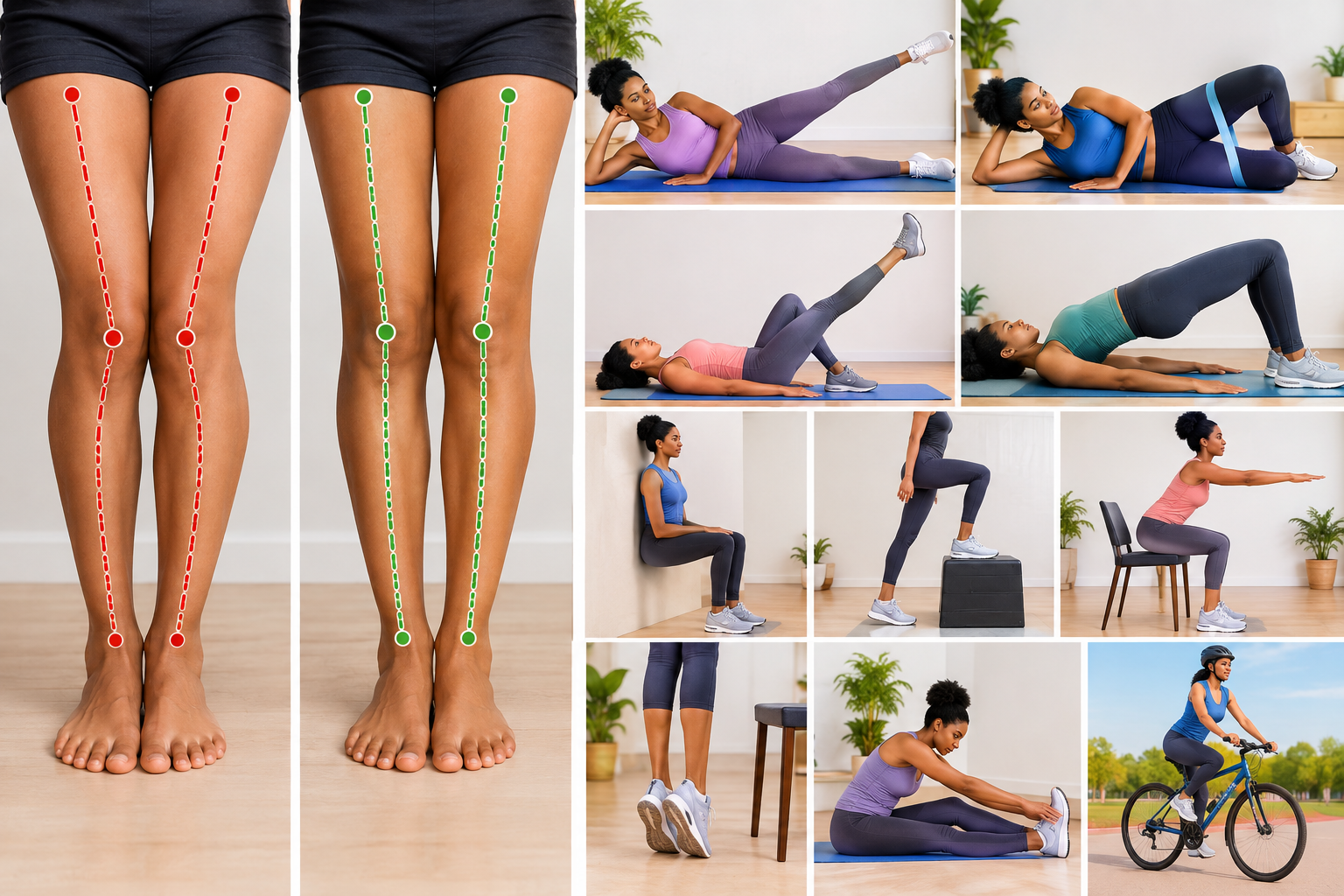
Sometimes, the way our legs look or move can make us wonder whether something is wrong. One common concern is knock knees, medically known as genu valgum.
Knock-knees occur when the knees angle inward and may touch while the ankles remain separated when standing with the legs together. This is common in children and can be a normal part of development. However, persistent knock knees in older children or adults, particularly when accompanied by pain or difficulty walking, may require professional assessment.
Exercise cannot necessarily change the shape of bones that have already developed. However, appropriate strengthening and stretching exercises can help improve muscle strength, flexibility, balance, and movement around the hips and knees. Physical therapy is sometimes recommended as part of managing knock knees and related movement problems.
Below are 10 exercises that can help strengthen the muscles that support healthy knee and leg movement.
1. Side-Lying Leg Raises
Side-lying leg raises target the muscles around the outer hip, including the hip abductors and gluteal muscles. These muscles help stabilize the pelvis and control leg movement.
How to do it:
- Lie on your side with your legs straight.
- Keep your upper leg straight without locking the knee.
- Slowly raise the upper leg.
- Hold briefly.
- Lower it slowly.
- Repeat on the other side.
Start with 2 sets of 10–15 repetitions per side and gradually increase as your strength improves.
The American Academy of Orthopaedic Surgeons includes hip abduction as part of a knee-conditioning program because it strengthens the hip and outer-thigh muscles that support knee function.
2. Clamshells
Clamshell exercises strengthen muscles around the hips, particularly the gluteus medius, which helps stabilize the hips and knees during movement.
How to do it:
- Lie on your side.
- Bend your knees comfortably while keeping your feet together.
- Keep your hips stacked.
- Slowly lift your upper knee while keeping your feet together.
- Do not rotate your entire body backward.
- Lower the knee slowly.
- Repeat.
Try 2 sets of 10–15 repetitions on each side.
3. Straight-Leg Raises
Straight-leg raises strengthen the quadriceps, the muscles at the front of the thigh that help support the knee.
How to do it:
- Lie on your back.
- Keep one leg straight.
- Bend the other knee if that is more comfortable.
- Tighten the thigh muscle of the straight leg.
- Slowly raise the leg.
- Hold briefly.
- Lower it with control.
A commonly used knee-conditioning variation is 2 sets of 15 repetitions per leg.
4. Glute Bridges
Glute bridges strengthen the buttocks and muscles around the hips, which play an important role in controlling the position of the legs.
How to do it:
- Lie on your back with your knees bent.
- Keep your feet flat on the floor.
- Place your arms beside your body.
- Tighten your abdominal and buttock muscles.
- Lift your hips slowly.
- Hold for a few seconds.
- Lower your hips gently.
Start with 2 sets of 10–15 repetitions.
5. Wall Sit
Wall sits can strengthen the quadriceps and other muscles supporting the knee.
How to do it:
- Stand with your back against a wall.
- Place your feet comfortably in front of you.
- Slowly bend your knees while sliding down the wall.
- Keep the movement controlled.
- Hold the position for several seconds.
- Slowly return to standing.
You do not need to go into a deep squat. If the exercise causes knee pain, stop and seek professional advice.
6. Step-Ups
Step-ups strengthen the muscles of the thighs, hips, and legs while also challenging balance and coordination.
How to do it:
- Use a low, stable step.
- Place one foot firmly on the step.
- Push through that foot to raise your body.
- Bring the other foot up.
- Step down slowly.
- Repeat on the opposite side.
Begin with 8–10 repetitions per leg.
Focus on keeping the knee aligned with the foot rather than allowing it to collapse inward.
7. Sit-to-Stand
This simple exercise strengthens the legs while practicing controlled movement.
How to do it:
- Sit on a sturdy chair.
- Place your feet comfortably apart.
- Lean slightly forward.
- Push through your feet to stand.
- Slowly sit back down.
- Repeat.
Try 2 sets of 8–12 repetitions.
If your knees hurt, reduce the number of repetitions or speak with a physiotherapist about modifying the exercise.
8. Calf Raises
Strong calf muscles support everyday activities such as walking, climbing stairs, and maintaining balance.
How to do it:
- Stand behind a sturdy chair or near a wall for support.
- Keep your feet comfortably positioned.
- Slowly raise your heels from the floor.
- Balance on the balls of your feet.
- Hold briefly.
- Lower your heels slowly.
Start with 2 sets of 10–15 repetitions.
9. Gentle Hamstring Stretch
Flexibility is an important part of a balanced exercise program. Stretching the muscles around the legs can help maintain comfortable movement.
How to do it:
- Sit or lie down in a comfortable position.
- Extend one leg.
- Gently stretch toward the leg without forcing the movement.
- Hold for about 15–30 seconds.
- Relax.
- Repeat on the other side.
The goal is a gentle stretch, not pain.
AAOS recommends combining strengthening with stretching as part of knee conditioning.
10. Low-Impact Walking or Cycling
Exercise does not always have to involve complicated movements.
Walking on a comfortable, level surface or cycling can provide low-impact activity while helping maintain general leg strength and mobility.
Start gradually and pay attention to how your knees respond.
If an activity causes pain, reduce the intensity or stop and consult a healthcare professional. Low-impact activity is commonly recommended when trying to exercise while reducing unnecessary stress on the knees.
Can These Exercises Actually Cure Knock Knees?
This is an important question.
Exercises do not necessarily straighten the bones responsible for structural genu valgum.
If knock knees are caused by the natural shape or alignment of the bones, especially in a skeletally mature person, exercises cannot simply reshape those bones.
However, strengthening the muscles around the hips and knees can help with strength, stability, movement, and functional control. Physical therapy may therefore be useful for some people.
For children, the situation can be different. Knock-knees are frequently part of normal growth and development, and many children naturally grow out of them.
How Often Should You Exercise?
There is no single exercise routine that is appropriate for everyone with knock knees.
A sensible approach is to begin gradually rather than exercising intensely every day.
For strengthening exercises, you might begin with 2–3 sessions per week, allowing your muscles time to recover. Gentle mobility or low-impact activity can be incorporated according to your comfort and fitness level.
If you are experiencing pain, swelling, or difficulty walking, it is better to get professional advice before increasing your exercise routine.
When Should You See a Doctor or Physiotherapist?
You should consider professional assessment if:
- Your knock-knees are painful.
- The alignment is getting worse.
- One leg appears significantly different from the other.
- You have difficulty walking or running.
- Your knees frequently swell.
- You have difficulty participating in normal activities.
- Knock knees persist or appear unusually severe in a child.
- You are concerned that an underlying bone or nutritional condition may be contributing to the problem.
A healthcare professional can examine your legs and determine whether further assessment, such as imaging, is necessary.
Listen to Your Body
Exercise should help you become stronger, not cause unnecessary injury.
Warm up before exercising, begin gradually, and perform movements with good control. AAOS advises that you should not ignore pain during a knee-conditioning program and recommends speaking with a doctor or physical therapist if an exercise causes pain.
Remember that everyone's body is different. An exercise that works well for one person may not be appropriate for another.
From Me To You
I believe, that taking care of our health should be part of everyday life.
Healthy living is not only about treating illness after it appears. It is also about learning how to care for our bodies, staying physically active, eating well, and seeking professional help when something does not feel right.
If you or someone you know is concerned about knock knees, do not be ashamed to seek help. Understanding your body is the first step toward taking better care of it.
Conclusion
Knock-knees can have different causes, and not every case requires treatment. For many children, the condition improves naturally as they grow. For others, particularly those experiencing persistent pain or significant alignment problems, professional evaluation may be necessary.
Exercises such as side-lying leg raises, clamshells, straight-leg raises, glute bridges, wall sits, step-ups, sit-to-stands, calf raises, gentle hamstring stretches, and low-impact activities can help strengthen and condition the muscles supporting the hips and knees.
The goal should not simply be to change how your legs look. It should be to build strength, stability, mobility, and confidence in movement.
Take care of your body today, and give it the support it needs for tomorrow.