The old mango tree stood at the center of Umudike Community, its wide branches providing shade to anyone who needed a place to rest. Every evening, children gathered beneath it to play while parents chatted after a long day's work.
It was a peaceful sight—at least on the surface.
One afternoon, twelve-year-old Chinedu sat quietly under the tree, watching the other children laugh. Unlike them, he wasn't eager to join the games. His teacher had noticed his silence in class, and even his closest friends could tell something was wrong.
As he sat there, an elderly woman named Mama Grace walked over carrying a basket of fresh vegetables from the market.
She smiled warmly.
"Why aren't you playing today?"
Chinedu looked down.
"I don't feel like it."
Mama Grace sat beside him.
"Sometimes when children become quiet, it's because their hearts are carrying something heavy."
The boy hesitated before speaking.
"My parents argue almost every day. My little sister cries every night. Nobody talks anymore unless they're shouting."
Mama Grace sighed gently.
"My child," she said, "when the foundation of a home begins to crack, everyone inside feels the shaking."
More Than Just Living Together
That evening, Mama Grace shared Chinedu's concerns—not by revealing his secret, but by gathering several parents under the old mango tree for one of the community's regular meetings.
She began with a simple question.
"What makes a family strong?"
One father answered,
"Providing food."
Another mother said,
"Paying school fees."
Someone else added,
"Having a nice house."
Mama Grace smiled.
"Those things are important, but a strong family is built on something much deeper."
She explained that families are not simply groups of people living under one roof. They are the first classrooms where children learn how to speak, how to forgive, how to solve problems, and how to care for others.
Long before children meet teachers, employers, or community leaders, they learn life's most important lessons at home.
A healthy family creates healthy individuals.
Healthy individuals create healthy communities.
The Power of Parenting
As the discussion continued, one young father raised his hand.
"I work long hours. Sometimes I think providing money is enough."
Mama Grace nodded kindly.
"Providing for your family is important, but children need more than food. They need your presence."
She explained that parenting is not only about meeting physical needs. It is about helping children grow emotionally, mentally, morally, and socially.
Good parenting includes:
- Listening without judgment.
- Teaching values through everyday actions.
- Encouraging rather than criticizing.
- Correcting with love instead of anger.
- Spending meaningful time together.
Children may not remember every gift they receive, but they will always remember how their parents made them feel.
When Communication Breaks Down
A young mother quietly spoke.
"My husband and I barely talk anymore. We only discuss bills, responsibilities, and problems."
Mama Grace smiled gently.
"Communication is the heartbeat of every family."
Without communication:
- Misunderstandings grow.
- Assumptions replace honesty.
- Resentment quietly builds.
- Relationships become distant.
She looked around the gathering.
"A family doesn't become stronger because they never disagree. It becomes stronger because they choose to listen before reacting."
Sometimes healing begins with simple conversations:
- "How was your day?"
- "Are you okay?"
- "How can I help you?"
Small questions often open the door to meaningful connection.
Families Shape Communities
The following week, something unexpected happened.
Several parents began eating dinner together without television or mobile phones. Children started sharing stories about school. Neighbors noticed fathers spending more time walking with their children in the evenings. Mothers began organizing small gatherings where families could support one another.
Slowly, the atmosphere in the community began to change.
Arguments became less common. Children smiled more. Neighbors looked out for one another.
One evening, Chinedu ran beneath the old mango tree laughing with the same friends he had once watched from a distance.
Mama Grace smiled quietly.
Healthy communities rarely begin in government offices.
They begin around family tables.
Social Responsibility Begins at Home
During another community meeting, Mama Grace asked everyone:
"What kind of community do we want our children to inherit?"
The answers came quickly:
- A peaceful one.
- A safe one.
- A caring one.
She nodded.
"Then we must first build peaceful, safe, and caring families."
Children who grow up surrounded by respect often learn to respect others.
Children who experience kindness are more likely to show kindness.
Children who learn responsibility at home become responsible citizens.
Families teach values that schools alone cannot.
Social responsibility begins with everyday examples:
- Helping a neighbor in need.
- Respecting elders.
- Caring for the environment.
- Being honest even when no one is watching.
- Serving others without expecting rewards.
Every strong family plants seeds that eventually grow throughout the community.
A Faith-Based Reflection
Many faith traditions teach that the family is one of society's greatest gifts.
It is within families that love is first experienced, forgiveness is first practiced, and compassion is first learned.
Strong families are not perfect. They face disagreements, disappointments, and difficult seasons.
But they choose unity over division, understanding over pride, and love over resentment.
When families are strengthened by patience, faith, and compassion, entire communities become stronger.
A Lesson Chinedu Never Forgot
Months later, Chinedu noticed something different at home.
His parents still faced challenges. Life was not suddenly perfect.
But they had started talking instead of shouting. They ate dinner together more often. His father apologized when he was wrong. His mother smiled more.
His little sister laughed again.
One evening, as the family walked home together after a community event, Chinedu looked up at his parents and smiled.
For the first time in a long while...
Home felt like home again.
From Me to You
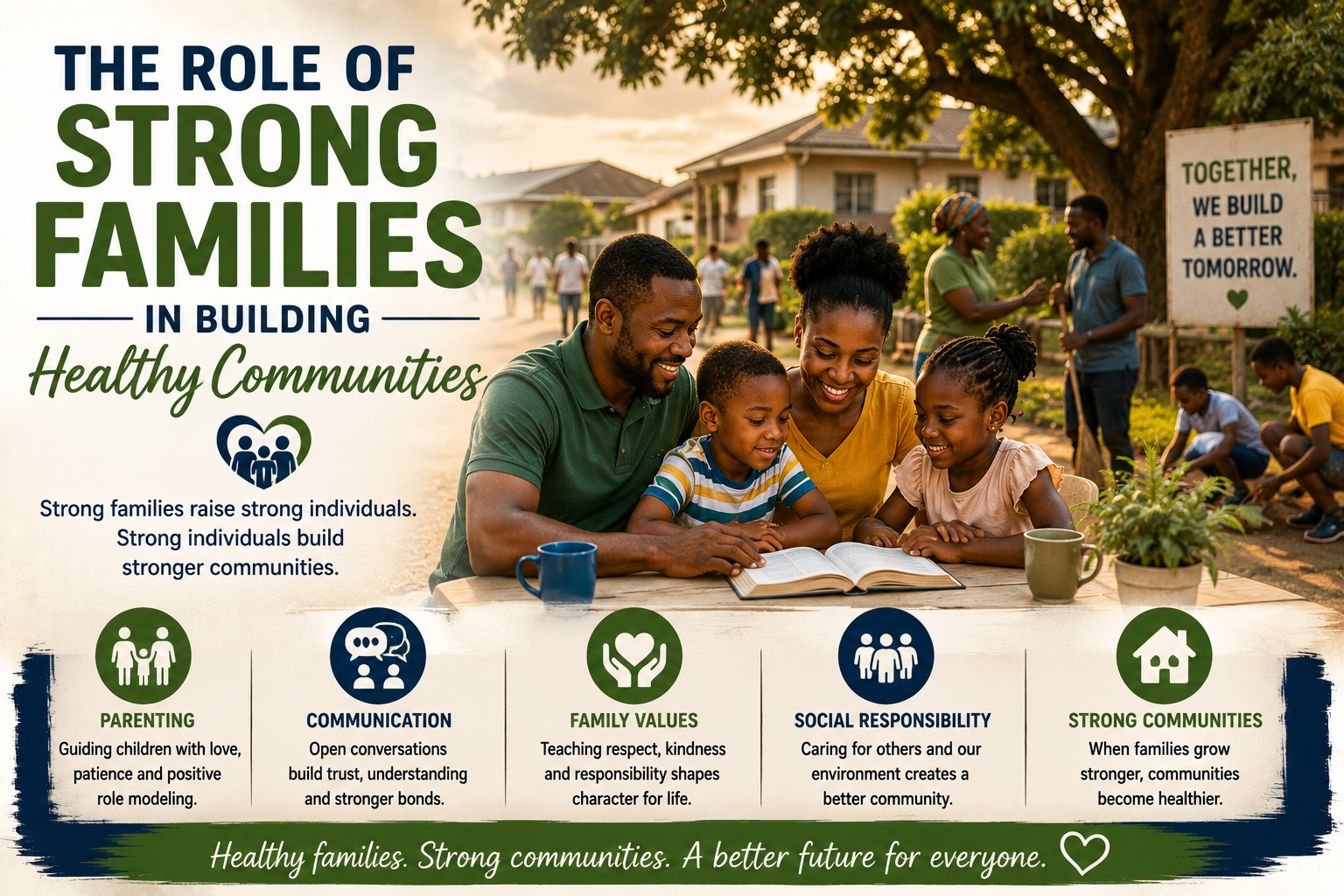
Communities are not built only with roads, schools, hospitals, or buildings.
They are built through families that choose love over conflict, communication over silence, and responsibility over indifference.
Every conversation shared around the dinner table...
Every lesson taught with patience...
Every act of kindness shown within the home...
Creates a ripple that reaches far beyond one family.
If we want stronger communities tomorrow, we must invest in stronger families today.
Conclusion
The strength of any community begins within its homes.
When families prioritize love, open communication, responsible parenting, and shared values, they raise individuals who contribute positively to society.
Healthy families create confident children, compassionate adults, and resilient neighborhoods. They teach the values that inspire cooperation, empathy, integrity, and service—qualities every thriving community needs.
Strong communities are not built overnight. They are built one family, one conversation, one act of love, and one generation at a time.
Because when families grow stronger, communities become healthier, hope becomes brighter, and the future becomes better for everyone.