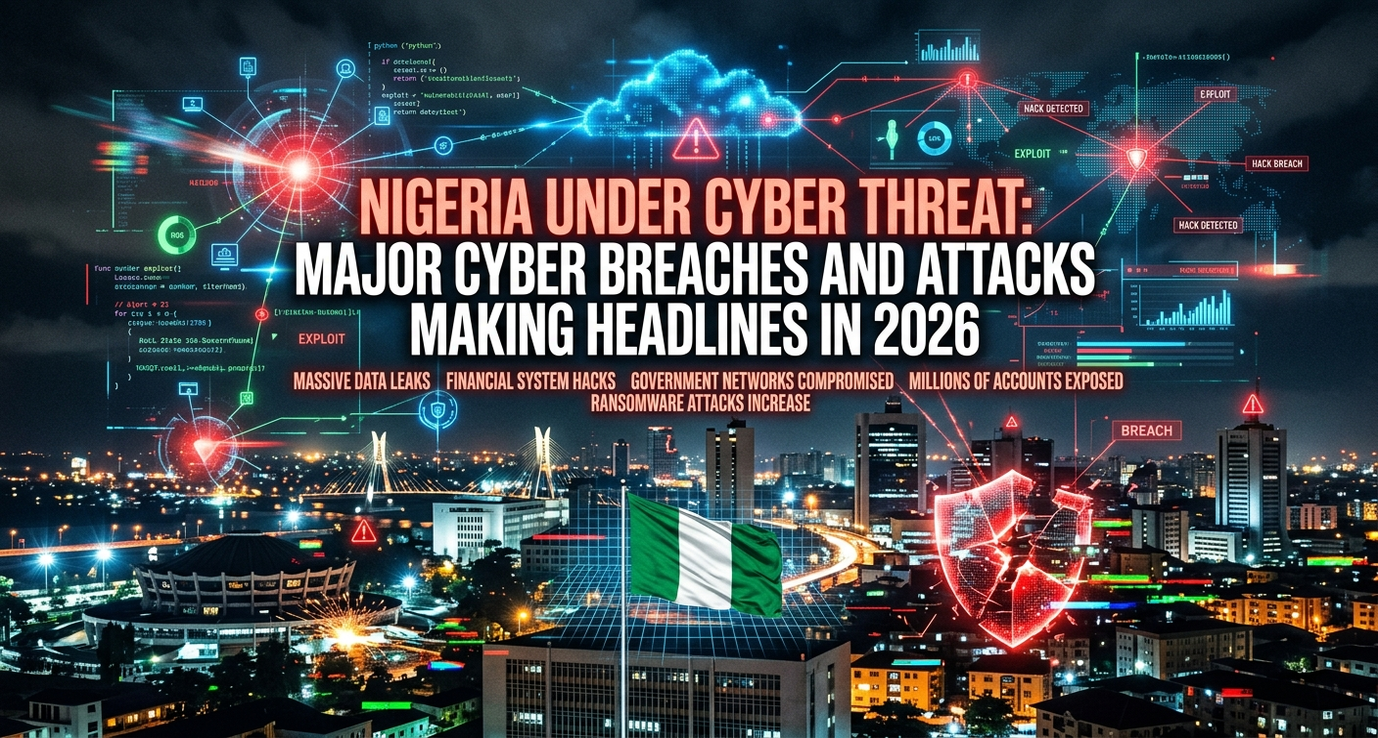
As Nigeria becomes increasingly digital, cybercriminals are finding new opportunities to target the systems, institutions, and personal information that millions of Nigerians depend on.
Nigeria's digital transformation has brought enormous benefits. From online banking and digital payments to government databases, business registration, education platforms, and other online services, more aspects of everyday life now depend on technology.
But with greater digital dependence comes greater cybersecurity risk.
In 2026, Nigeria has witnessed a series of reported cyber incidents, alleged data breaches, investigations, and large-scale cyberattack attempts. These incidents have raised important questions about the security of personal information and the ability of organizations to protect the people who trust them with their data.
According to Kaspersky data reported by BusinessDay, Nigeria recorded approximately 1.6 million web-based cyberattack attempts during the first half of 2026, placing the country among the five most targeted countries in the Middle East, Türkiye, and Africa region during that period.
The growing threat makes one thing clear:
Cybersecurity is no longer only an IT issue. It is a national, organizational, and personal responsibility.
The Corporate Affairs Commission Data Breach Investigation
One of the most significant cybersecurity stories of 2026 involved the Corporate Affairs Commission (CAC).
In April, reports emerged of unauthorized access to parts of the CAC's information systems. The CAC acknowledged that it was reviewing a cybersecurity incident involving unauthorized access to limited aspects of its systems.
The Nigeria Data Protection Commission (NDPC) subsequently launched an investigation into the reported breach. The investigation included areas such as access-control mechanisms, data-protection impact assessments, vulnerability assessments, penetration testing, and the security of third-party data processors.
The incident was particularly concerning because the CAC manages important corporate information relating to businesses operating in Nigeria.
It demonstrated how a breach involving a major public database can potentially affect not only one organization but also businesses, individuals, and the wider economy.
Remita and Sterling Bank Under Investigation
Another major cybersecurity story emerged within Nigeria's financial ecosystem.
In April 2026, the NDPC announced investigations into an alleged data breach involving Remita Payment Services, Sterling Bank, and other entities.
The investigation followed reports that sensitive customer information may have been compromised. The NDPC issued notices of investigation and began examining the nature and scope of the alleged incident. The case highlights a particularly important concern.
Financial institutions and payment platforms hold extremely valuable information.
Names, account details, transaction information, identification data, contact information, and other personal records can become attractive targets for cybercriminals.
If such information falls into the wrong hands, it can potentially be used for phishing, identity theft, fraud, impersonation, and other forms of cybercrime.
This is why protecting financial data requires more than passwords alone.
A Reported 250GB CIBN Data Breach
The Chartered Institute of Bankers of Nigeria (CIBN) also became the subject of a major cybersecurity report in April.
Reports alleged that approximately 250GB of data belonging to the organization had been compromised and leaked online.
The reports raised concerns because the alleged information reportedly included sensitive records associated with members and internal organizational information. However, because the incident was reported as an allegation, it is important not to treat every claim about the contents of the alleged leak as independently confirmed.
The incident nevertheless demonstrates an important cybersecurity reality:
Professional and membership organizations can also become valuable targets.
Organizations may hold identification documents, photographs, educational records, employment information, financial information, and other personal details that criminals can potentially exploit.
The NEMIS Cyberattack Controversy
Cybersecurity concerns also reached Nigeria's education sector in June.
Reports emerged suggesting that the Nigeria Education Management Information System (NEMIS) had experienced a possible cyberattack.
However, this case is particularly important because the Federal Ministry of Education rejected the reports, stating that NEMIS had not been hacked or breached and that the platform remained secure and operational.
This incident provides an important lesson about cybersecurity reporting:
Not every suspected cyberattack is a confirmed breach.
Organizations, journalists, cybersecurity researchers, and members of the public must carefully distinguish between the following:
- A suspected attack
- A reported breach
- A threat actor's claim
- An ongoing investigation
- A confirmed compromise
Responsible reporting is essential because inaccurate information can create unnecessary panic and damage public trust.
Nigeria Is Also Facing a Growing DDoS Threat
Data breaches are not the only concern.
In May 2026, Nigerian authorities warned about increasing Distributed Denial-of-Service (DDoS) attacks targeting digital infrastructure.
Unlike a traditional data breach, a DDoS attack primarily attempts to overwhelm a service with enormous amounts of traffic, potentially making websites or online services unavailable.
The Federal Government and the NDPC warned that the country was experiencing an intensifying wave of DDoS attacks affecting digital infrastructure.
For organizations that depend heavily on online services, even temporary disruption can have serious consequences.
Imagine being unable to access:
- Banking services
- Government platforms
- Business websites
- Healthcare systems
- Educational platforms
- Payment services
For organizations operating critical services, availability is just as important as confidentiality and integrity.
Nigeria's Cyber Threat Is Bigger Than Individual Breaches
Looking at these incidents individually can make them seem unrelated.
But together, they reveal a broader trend.
Nigeria is becoming increasingly dependent on digital infrastructure while simultaneously facing sophisticated cyber threats.
The country's cybersecurity landscape includes:
Data Breaches
Sensitive information being accessed or exposed without authorization.
Phishing
Attackers tricking people into revealing passwords, financial information, or other sensitive data.
Ransomware
Malicious software used to lock systems or data and demand payment.
DDoS Attacks
Attempts to overwhelm online services and make them unavailable.
Credential Theft
Criminals obtaining usernames and passwords to gain unauthorized access.
Social Engineering
Manipulating people into providing information or performing actions that compromise security.
These threats can affect governments, banks, businesses, NGOs, schools, hospitals, and ordinary individuals.
Why These Breaches Matter to Ordinary Nigerians
It is easy to think:
"I am not a big company. Why would hackers care about me?"
But cybercriminals don't only target large organizations.
Your personal information has value.
- Your email address.
- Your phone number.
- Your passwords.
- Your bank details.
- Your National Identification Number.
- Your photographs.
- Your location information.
- Your social media accounts.
- Your employment information.
When combined, such information can potentially be used to impersonate you, scam you, access accounts, or target people you know.
That is why cybersecurity must become part of everyday life.
What Organizations Must Do
The recent incidents should encourage Nigerian organizations to strengthen their cybersecurity practices.
Organizations should consider:
- Implementing multi-factor authentication.
- Regularly updating systems and software.
- Conducting vulnerability assessments and penetration testing.
- Limiting employee access to sensitive information.
- Encrypting sensitive data.
- Monitoring networks for suspicious activity.
- Maintaining secure backups.
- Training employees to recognize phishing attacks.
- Reviewing third-party vendors and processors.
- Having a clear incident-response plan.
- Regularly reviewing data-protection practices.
The NDPC has also emphasized measures including stronger identity and access controls, MFA, zero-trust architecture, network segmentation, data-protection impact assessments, and appropriate security standards.
What Individuals Can Do
Cybersecurity does not belong only to organizations.
Every Nigerian who uses a smartphone, computer, bank account, social media platform, or online service has a role to play.
Start with simple habits.
Use Strong, Unique Passwords
Avoid using the same password everywhere.
If one account is compromised, attackers may try the same password on your other accounts.
Turn On Multi-Factor Authentication
Where available, activate MFA.
Even if someone obtains your password, an additional authentication factor can make unauthorized access more difficult.
Be Careful With Links
Don't automatically click links received through email, WhatsApp, SMS, or social media.
Verify the sender and destination before entering sensitive information.
Protect Your Personal Information
Don't publicly share information that could help criminals answer security questions or impersonate you.
Keep Your Devices Updated
Software updates often contain important security fixes.
Ignoring updates can leave known vulnerabilities unpatched.
Watch Your Bank and Online Accounts
Pay attention to unusual transactions, login alerts, password-reset messages, and other suspicious activity.
If something looks wrong, act quickly.
The Bigger Lesson for Nigeria
The cybersecurity incidents of 2026 should not only generate fear.
They should generate action.
Nigeria is rapidly becoming a digital economy. Businesses are moving online. Government services are becoming digital. Financial transactions are increasingly electronic. Personal information is being stored and processed across interconnected systems.
That transformation can create enormous opportunities.
But it also creates enormous responsibility.
Every organization that collects personal information has a responsibility to protect it.
Every employee who handles sensitive information has a responsibility to handle it carefully.
And every individual who uses digital services has a responsibility to practice basic cybersecurity hygiene.
From Multi-Life Savers
At Multi-Life Savers, we believe that protecting people means responding to the realities affecting communities today.
Cybersecurity may appear to be a purely technological issue, but its consequences are deeply human.
A stolen identity can affect a person's finances.
A compromised account can destroy someone's savings.
A leaked medical record can violate someone's privacy.
A hacked organization can disrupt services that families depend on.
Behind every piece of data is a human being.
That is why digital safety deserves the same seriousness as other forms of community protection.
Conclusion
Nigeria's cybersecurity story in 2026 is still developing.
From the reported CAC incident and the NDPC's investigation into Remita and Sterling Bank to the reported CIBN breach and the DDoS warnings issued by authorities, the country has experienced a series of events that demonstrate how rapidly the cyber threat landscape is evolving.
At the same time, the NEMIS episode reminds us that suspected attacks must be investigated carefully and reported responsibly.
The lesson is not that Nigeria's digital future is unsafe.
The lesson is that Nigeria's digital future must be protected.
Cybersecurity is no longer something that only concerns IT departments.
It concerns businesses.
It concerns government.
It concerns schools.
It concerns NGOs.
It concerns families.
And it concerns every Nigerian who lives, works, studies, banks, communicates, or does business online.
The more connected Nigeria becomes, the more important cybersecurity becomes.
And protecting our digital spaces is ultimately about protecting people.